Core Workouts for Beginners: A Complete Guide
A strong core is the foundation of a healthy and fit body. Your core muscles support your spine, improve posture, enhance balance, and make everyday activities easier. Whether your goal is weight loss, better athletic performance, or improved overall fitness, beginner-friendly core exercises are a great place to start.
What Is the Core?
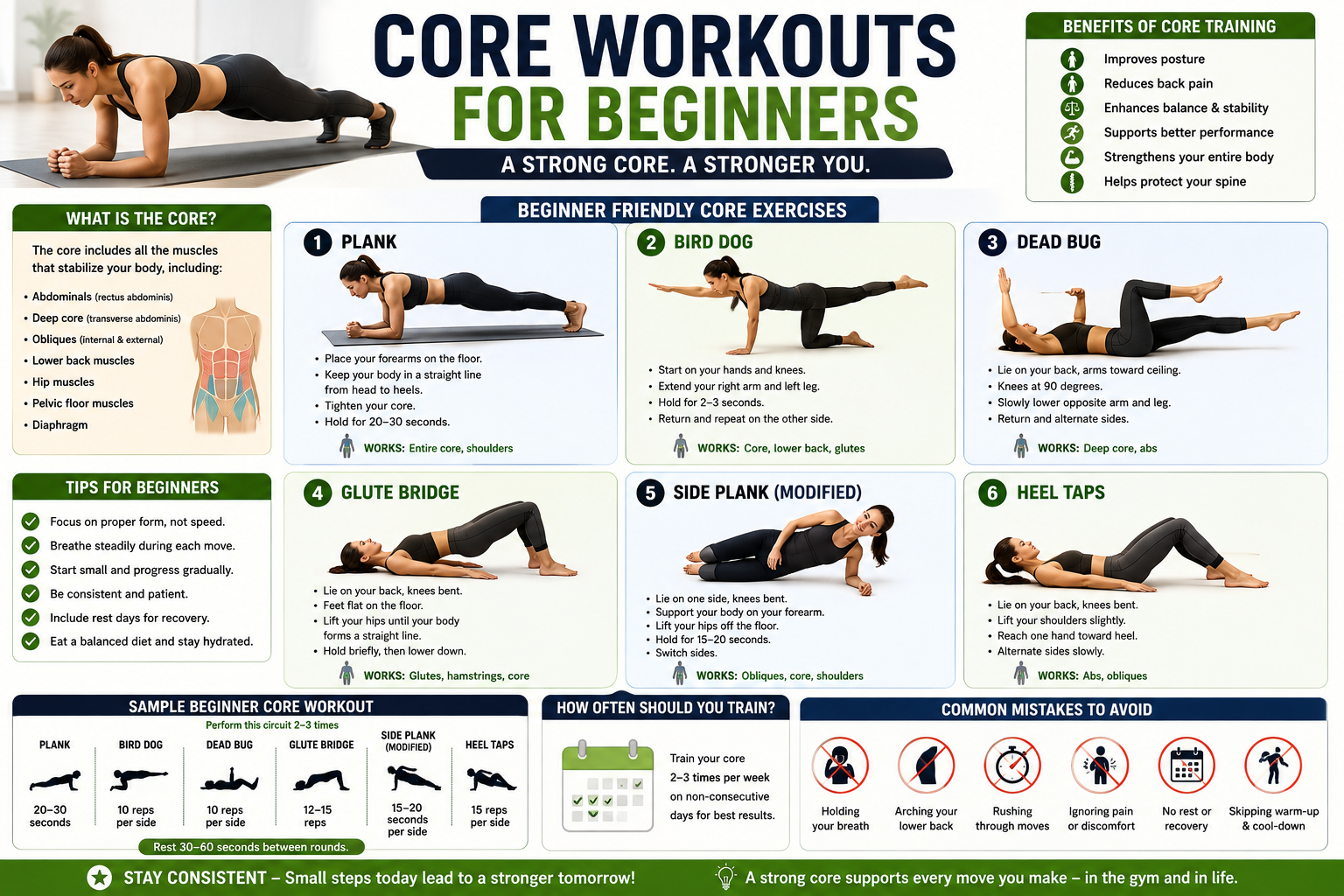
The core is more than just your abdominal muscles. It includes several muscle groups that work together to stabilize your body, including:
- Rectus abdominis (front abdominal muscles)
- Transverse abdominis (deep core muscles)
- Internal and external obliques (side muscles)
- Lower back muscles
- Pelvic floor muscles
- Hip muscles
- Diaphragm
Benefits of Core Workouts
Regular core training offers many health and fitness benefits, including:
- Improves posture
- Reduces the risk of back pain
- Enhances balance and stability
- Supports better athletic performance
- Makes everyday movements easier
- Helps protect the spine
- Improves overall body strength
Beginner-Friendly Core Exercises
1. Plank
The plank is one of the best exercises for strengthening the entire core.
How to do it:
- Place your forearms on the floor.
- Keep your body in a straight line from head to heels.
- Tighten your abdominal muscles.
- Hold for 20–30 seconds.
2. Bird Dog
This exercise improves balance and strengthens both the core and lower back.
How to do it:
- Start on your hands and knees.
- Extend your right arm and left leg.
- Hold for 2–3 seconds.
- Return to the starting position.
- Repeat on the opposite side.
3. Dead Bug
The dead bug strengthens deep core muscles while promoting spinal stability.
How to do it:
- Lie on your back with your arms extended toward the ceiling.
- Raise your knees to a 90-degree angle.
- Slowly lower your right arm and left leg.
- Return to the starting position.
- Alternate sides.
4. Glute Bridge
Although it targets the glutes, this exercise also strengthens the core and lower back.
How to do it:
- Lie on your back with your knees bent.
- Keep your feet flat on the floor.
- Lift your hips until your body forms a straight line.
- Hold briefly and lower slowly.
5. Side Plank (Modified)
This exercise targets the obliques and improves lateral stability.
How to do it:
- Lie on one side with your knees bent.
- Support your body on your forearm.
- Lift your hips off the floor.
- Hold for 15–20 seconds.
- Switch sides.
6. Heel Taps
Heel taps are a beginner-friendly exercise that activates the abdominal muscles.
How to do it:
- Lie on your back with your knees bent.
- Lift your shoulders slightly.
- Reach one hand toward the same-side heel.
- Alternate sides slowly.
Sample Beginner Core Workout
Perform the following circuit 2–3 times:
| Exercise | Repetitions/Time |
|---|---|
| Plank | 20–30 seconds |
| Bird Dog | 10 reps per side |
| Dead Bug | 10 reps per side |
| Glute Bridge | 12–15 reps |
| Modified Side Plank | 15–20 seconds per side |
| Heel Taps | 15 reps per side |
Rest for 30–60 seconds between rounds.
Tips for Beginners
- Focus on proper form rather than speed.
- Breathe steadily throughout each exercise.
- Start with shorter holds and fewer repetitions.
- Increase the duration and intensity gradually.
- Include rest days to allow muscles to recover.
- Pair core workouts with full-body strength training and cardio for overall fitness.
Common Mistakes to Avoid
- Holding your breath during exercises.
- Arching your lower back.
- Rushing through movements.
- Ignoring pain or discomfort.
- Skipping warm-ups and cool-downs.
- Training the core every day without adequate recovery.
How Often Should You Train Your Core?
Beginners can perform core workouts 2–3 times per week on non-consecutive days. This provides enough stimulus for strength gains while allowing time for recovery.
Final Thoughts
Core workouts are an essential part of any fitness routine. By practicing beginner-friendly exercises such as planks, bird dogs, dead bugs, glute bridges, side planks, and heel taps, you can build strength, improve posture, reduce the risk of injury, and support your overall fitness goals. Stay consistent, focus on proper technique, and gradually increase the challenge as your core becomes stronger.